
Crocodile with Hubbard squash and gourd eyes
Winter squashes are nutritional powerhouses that are not only luscious and sweet; in the kitchen they are extremely versatile. Over the years I have studied this vegetable and cooked dozens of different types. Today, I would say, my favorites are the sweet butternut, I find it the easiest to peel and the cubes are great for roasting; Kabocha (Japanese chestnut squashes) that have such dense flesh and meatiness that are perfect for baking and pureeing; and, I love the acorn types for their rich mellow flavor that pairs so well with all type of nuts and brown sugar.
Today, winter squashes are enjoyed in most parts of the world. In Mexico, where they are native, winter squashes are made into a puree and baked inside empanadas, and the seeds are roasted and salted or added to candies, even ground into their famous mole sauces. Italians add winter squash cubes to risotto and soups, and they mashed and seasoned the pulp with herbs and spices to fill raviolis. In gay Paris they use the heirloom pumpkin Rouge Vif d’Etampes to bake a rich leek and cheese soup and create a rich gratin by layering the squash and baking it with cream and hazelnuts.
In this country, for centuries the Native Americans have roasted whole squash in the coals or added the cubes to stews along with venison or turkey and flavored them with chilies. The colonists grew and cooked winter squash as well. They mashed the flesh and sweetened the pulp with sugar or molasses and made them into pies and puddings, which were served as a side dish to the meal with other vegetables and starches. Not until the twentieth century were pies and puddings accepted as dessert items. Who knew?
Enjoy winter squash for the next four or five months, then next spring, after all threat of frost is over, choose your favorite varieties and plant them in great soil and in full sun. I’ll post photos of how to include these exciting plants in your landscape and give you some growing hints.

Neighborhood kids harvesting pumkins from my garden
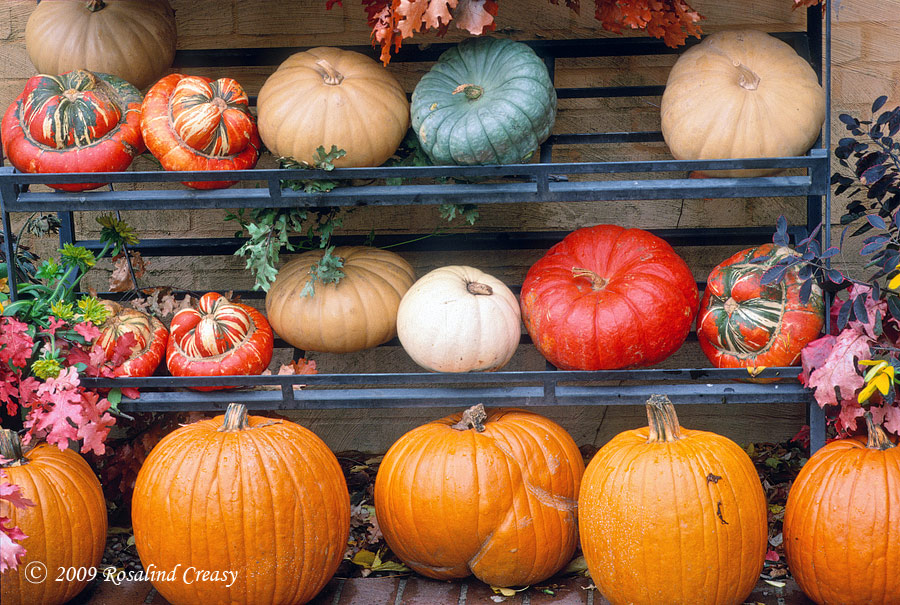
Harvest of pumpkins at Tra Vigna Restaurant in Napa
White pumpkin jester "jack-o-lantern" with chilis
Winter Squash Recipes
Baked Winter Squash with Maple Nut/Seed Butter
A wonderful compliment to squash is a nut or seed butter. The rich flavors seem meant for each other. You can make your own nut or seed butter, or many types are available in natural foods and specialty stores.
Basic baking directions are given below; the time will vary and the number of people served will depend on the size and variety of squash.
- 2 acorn or other small squash (about 1 1/4 pound each), or 1 medium squash (about 2 1/2 pounds)
- 3 tablespoons each dairy butter, nut or seed butter, and maple syrup
Place squash on a baking pan and bake at 350 F. for 3/4 to 1 1/2 hours, until soft. You may want to turn the squash a couple of times for more even cooking. Cut in half and remove seeds, (save to wash and toast for snacks if you like), and strings; if using 1 squash, cut again to make 4 servings. Put back on baking pan cut sides up. In a small saucepan, melt dairy butter, add nut or seed butter and syrup, and stir to mix. Spoon mixture into squash cavities and coat surfaces. Return to oven for about 10 minutes to heat through before serving. Serves 4
Classic Home-Grown Pumpkin Pie
Some pumpkins do not make good pies. Select a pumpkin bred for pies, not a Jack-o-lantern type. If you can’t find a good pie pumpkin use a Butternut squash, they make great “pumpkin” pies.
- 1 3/4 cups pumpkin puree (see below), or squash
- 3/4 cup white or brown sugar
- 1 cup milk or cream
- 1 teaspoon cinnamon
- 1/2 teaspoon ginger
- 1/4 teaspoon nutmeg
- 1/8 teaspoon allspice or cloves
- 3 eggs
- 1 unbaked 9-inch pie shell
Preheat oven to 350 degrees F.
To make your own pumpkin puree: Cut pumpkin or squash in half, remove seeds and strings, and place cut-side down on a greased cookie sheet. Bake at 350 degrees F. until very soft, 1 hour, or longer, and let cool. Remove skin and any coarse fibers, and puree flesh in a blender, food processor, or food mill. One small to medium pumpkin makes about 1 quart of puree.
Place all the ingredients except pie shell in a blender and blend. (You may have to do this in 2 batches, depending on capacity of blender. If so, mix the batches before pouring into the pie shell.) Pour into 9-inch pie shell. Bake at 425 degrees for 15 minutes. Reduce temperature to 350 degrees and bake 45 minutes longer or until set and a knife inserted into the middle comes out clean. Let cool at least 1/2 hour before serving. Makes 1-inch 9 pie.

by Rosalind Creasy
Kari Lonning - Wonderful crocodile! It’s fun to see people play with their food! (found your blog because of a tweet from @betweenthelimes)
Claudia dos Reis - Lovely! I received the Mother Earth today, and the most beautiful picture was yours, specially that one with the rooster!
I am looking it, and thinking about my own garden that I will have. My garden, like you can see in the pictures (http://claudiaswildgarden.blogspot.com/)is small but is a refugee for many wild birds in the village. I planning to get a bigger place to work on these ideas with children, and conservation at same time. I am selecting good ideas like that ones you have. Beautiful!
DOROTHY RIENKS - May I add another ‘recipe’or two?
When I ‘clean’ out my pumpkins or squashes, I roast all the seeds and stringy pulp to the point of almost charred and grind the result to powder in my blender.
The powder goes into a fairly large-holed shaker and is added to cream soups as garnish, to salads for crunch and on many things instead of salt. Delicious nutty flavor. AND nothing goes to waste (my mantra)
Raw pumpkin pulp whipped with equal amount of glycerin or yoghurt makes a nice soothing facial/mask. spread on and let set for 10 minutes and rins off with cool water. Skin glows.
First Frost: Is There Still Time? | BBB Seed - [...] http://www.rosalindcreasy.com/holidays-with-your-edible-landscape-halloween-fun/http://www.dailymail.co.uk/news/article-2054719/Snow-storm-2011-New-York-3-dead-2m-power.html [...]